

Welcome to the Guncad Digest! This newsletter will regularly round up the best and most interesting 3D2A releases, betas and news.
If you want the Guncad Digest delivered straight to your inbox, you can subscribe to this Substack.
You can also follow us on Twitter, Instagram, Facebook, or Reddit, where we’ll post notifications when a new issue of the Digest is live!
Apologies for the delay! We got so busy in September that we missed an issue, but we’re back with a massive mega-issue with double the normal content!
In today’s Digest:
New Releases:
In this section, we cover new file releases that we find notable. If something catches your interest, go download and start printing!
Urutau Mk2: Smaller, Sleeker, More Compact, Fully DIY

One of the most popular DIY guns just got a sequal! Developers Joseph the Parrot and rsmith28, in concert with Black Lotus Coalition, are proud to present the Urutau Mk2!
While Joseph himself was not involved in the final testing and release of the Mk2, it was more or less development-complete at the time of his unjust arrest. What’s new between this and the original Urutau Mk1?
The theme of the Mk2 is “compactness.” The original Urutau might be thought of as a full-sized rifle; the Mk2, by comparison, is designed and intended to be built as an SBR. It is smaller than the original FGC-9.
To be clear, at time of writing, the Mk2 can only be built as an SBR - there is no configuration sized for rifle length. Americans can easily get their $0 Form 1 (use this Reference Card to help) if desired, or they can take advantage of the Jensen ruling and go without.

There are a handful of other small usability / quality of life changes to the Mk2, but for the most part the design’s internals are the same as the proven Mk1 - just smaller. It is available now to download and build - kits are available at 3D2A.com!
Remember that Joseph remains in prison as his trial works its way through the Brazilian “justice” system. I encourage you to support his family and legal effort by donating to his official GiveSendGo.
NOTE: there is an individual on Odysee claiming to be giving away, or selling, Joseph’s designs. This includes full auto versions of the Urutau Mk2 and others. Be aware that any designs this person may have are outdated and have not been vetted / tested. STAY AWAY.
SMP5K Releases: Now I Have A (Sub)Machine Gun

Following a banger with a banger - Stubbs from Black Lotus Coalition, designer of such hits as the SMP40, has released the SMP5K, a 3D printable MP5K design!
The design is actually a remix of the Yippee Ki Yay from Kaewon, and reuses many of its parts. The major improvement is the adoption of a CMMG Bravo conversion bolt, instead of Kaewon’s fully DIY design. Fully DIY is cool, but hard to get running - the SMP5K, on the other hand, goes together like legos!

As with all Stubbs designs, there’s about a million variants and furniture options - his goal was apparently to allow you to build every MP5K variant ever produced, no matter how obscure.
Kits are available from 3D2A.com, as well as a Printing Guide to help source parts, and a build video. Grab these and get building!
This Printable Tavor Was Promised To Me 3000 Years Ago

Back in Issue 31 we mentioned a printable Tavor lower entering beta - since that time we have seen several more designs pop up, including from quite notable developers!
Today we’ll look at the PAr-21 from Nopel, a thoroughly documented printable receiver design. Included in his release package is a “semi-only” version of the receiver which contains denials to block the installation of an unmodified bolt. Instructions are provided for how to modify the bolt to force it into semi-only mode.
A NFA version of the receiver, lacking these denials, is also included in the build package for any SOTs wanting to play with it!
While we’re on the subject, we will also note the VA CTAR-21 receiver from Vanguard Arms, which is less a printable receiver and more a reference model for anyone developing Tavor parts and accessories. This will be of use to devs as we see more work done in this area!
Like the Nylaug, the Tavor is one of those dream guns that, until the advent of 3D printing, was relatively inaccessible. Imported parts kits and printable receivers are now making this dream a reality. Get building!
Sidewinder Stens Your RXM

Well that’s certainly a series of words. The Sidewinder RXM PDW from Sum One explores territory I never even considered. Like other printed PDWs it mounts a slide on a printed PDW chassis - it simply does so at a 90 degree angle, creating what is essentially a side-feed system.
It gets better! Optional 45 degree pic adapters allow you to mount your optic and brace such that neither are in line with the grip:

I hate it. I love it. It’s pure 3D2A. Requires an RXM chassis, a slide (Dagger recommended) and a high strength M4x40 bolt to act as a “firing pin adapter.”
I’d better start seeing these at local steel matches!
Stop FTN5 Baffle Strikes with the Unsounding Rod

We love the FTN series here at the Guncad Digest, but we also must admit that this series - particularly the FTN5 - is prone to baffle strikes, due to the difficulty of perfectly threading your metal adapter into the printed suppressor. But it sounds like this problem has been solved!
Developer Squirt Emporium aka ButtstufferMan recently released the Unsounding Rod, a tool to help you install your thread adapter perfectly. Place the adapter on the base of the rod, slide the rod into the suppressor such that it aligns with the bullet path, then work the threads into the printed plastic.
Now available for both 9mm and .22LR FTN5s!
GP9-SA - Ciwielab Design Updated and Simplified by DBFirearms

Somehow I haven’t yet written about the GP9, despite its surprising popularity - mea culpa! The design originates with the very prolific ciwielab, and is best described as a Glock chassis with B&T TP9 aesthetics.
The design got popular enough to merit a remix from DB Firearms, who transformed it into the GP9-SA. The main changes here are to simplify assembly, improve takedown, standardize grips, and introduce some aesthetic changes. I particular appreciate the replacement of all heatsets with captive square nuts - it’s 2026 guys, stop using heatsets!
The design is available to download and print now. Kits are available at DB’s website!
Cartridge Corner:
This ever-changing section focuses on whatever interesting subtopic I find notable this week. Due to some major DIY ammo releases, today’s theme is “Cartridge Corner”. Read on!
9x23 Stark: First Part of True DIY 9mm Project Enters Public Beta

The Urutau Mk2’s release is extremely exciting, but there’s an even more exciting element that we didn’t cover in our writeup above. This is the first public announcement of a DIY ammo design called the 9x23mm Stark.
A brief history lesson: the DIY gun movement as we today recognize it has its roots in the 90s. That same movement - and often the very same people - often concerned themselves with DIY ammunition as well. This is understandable - a DIY gun doesn’t do much good if you can’t feed it, and “ban the ammo” has been a common refrain by antigunners since time immemorial.
Luty attempted DIY ammo, and Aardvark Reloading has been working on DIY ammo projects for over a decade. Stark reactivated dummy 9mm rounds for his FGC-9 and published the ButWhatAbout guide. Yet none of these projects felt like “true” DIY ammo, that literally manufactured every part of the cartridge, including the powder and primer compound. Until now.
The 9x23mm Stark is the first project I’ve come across that truly seems to accomplish full DIY ammo in a realistic and accessible way. This project appears to have been in progress since 2020 and, at least at this time, is being led by developers White Rose and Optimus Synthesis. Its announcement in the Urutau Mk2 documentation was the first I’ve ever heard of it, and so I was thrilled when only a week later, the first beta version of the project was released as well.
The project’s fantastic document walks you through building everything for a 9mm round. 9x23 Stark uses a multipart system for its cartridge:
A brass sheet is drawn through successive DIY dies (made using shaft collars in printed holders) using a shop press to form the “main” shell
A similar approach is used to draw and shape the primer cup from brass sheet
The primer anvil is made using a staple and a printed bending
A drilled aluminum cylinder holds the primer cup and acts as the cartridge rear
A drilled screw connects the shell and aluminum cylinder together and acts as the flash hole
The projectile can be cast from lead and optionally electroplated, following instructions in the ButWhatAbout Volume 2 guide.
This process produces a cartridge that is a few mm longer than a standard 9mm round, but reportedly with comparable ballistic performance.
The same developers have created documentation for the energetics to load your round with: Vectorite smokeless powder and KFC-25 primer compound, both of which seem to be based on expired patents and both of which can be relatively easily DIY’d.
These projects are not, at time of writing, released yet. KFC-25 was briefly uploaded, but has since been removed - I suspect the team wants more time to polish it before full release.
As such, here is where we stand: the portion of the 9x23 Stark project related to fabricating the cartridge has been released, and is in open beta. In order to prime and load the cartridge, you’ll need to use factory pistol primers and commercial smokeless, until the DIY versions of those products are released as well.
I expect we’ll start to see performance reports over the next several months (and I certainly intend to contribute to that myself.) I strongly encourage anyone reading this to consider trying this project out. Having reviewed it, I believe this is the real deal, and if our community stands for anything, it is for the promotion of projects such as this.
We’ll continue to write updates in future issues about this project. Keep an eye out!
BLC Brings Printed Ammunition to Open Beta

Great minds think alike, and it seems by sheer coincidence, Black Lotus Coalition has also opened up the Printed Ammo Project beta for all to join. This project takes a fundamentally different approach to DIY ammunition, centered around printing the shell as a single unit and using commonly available items (fishing weights, etc.) as projectiles. Commercial primers and powder is required.
This project has its origins in the MrDeep Ammo Packs. Modeled cartridges include 7.35 Carcano, 30-40 Krag, 45LC, .45-70, .577-450 Martini Henry and more.
As you can surely tell, the use case here is a little different! The idea seems to be to make easily accessible plinking rounds for historic guns and uncommon cartridges. Testing does reveal that printed shells can produce lethal power, but their power will always be limited by the nature of the printed shell.
Unlike most BLC betas, you do not need to be a BLC member to join this one. It’s open to the world - so if you’ve got an old gun and you want to stop paying $5 a round, check this project out and help test!
.22LR Bullet Mold Mold (That’s Two Molds)

Wrapping up our Cartridge Corner is a printable “.22LR Bullet Maker” from developer B4SIK. This design shows quite nicely how to use 3D printing tech to help with casting.
It works as follows: you print the “mold former”, assemble it, and cast the bullet mold with gypsum. Once it sets, remove the printed PLA and pour molten lead into your gypsum mold. If done properly you’ll get a nice set of .22LR projectiles, ready to be loaded into nailgun blanks or whatever else!
I’d like to see a set of these for every caliber. Someone make a 9mm one for use with 9x23 Stark!
Updates:
In this section we will mention updates to major releases - fixes, new variants, etc.
FTN6 Updates to 6.1

It was somewhat ironic that the release of a printed suppressor was accompanied by so much noise. The drama around the FTN6 has thankfully died down, and a month later an update to the files has been released, the FTN6.1. What’s in the update?
Changes include:
Adding a new .22LR suppressor, the FTN.6 Rimfire Elite, which the documentation claims is now the quietest rimfire FTN in the entire series. As small as the FTN.5 Rimfire, but with better flow-through channels!
Improved insert files for the Lugnut blast shield.
Modification to the D Cell files, making them easier to print and install
Due to reported problems, the washer has been removed from the FTN5.5, FTN.6 Rifle Flow and BLackout.
All 5.56 baffles are switched to the FTN.4 design, which reportedly provides better longevity
New low profile lid added to the 9mm Boostered suppressor, allowing it to utilize a wider variety of screw head types.
The release document also includes a section addressing some common questions, concerns and feedback. My favorite part is a section addressing the misconception that the FTN.6 is meant to “replace” earlier versions - as the document notes, “The FTN series isn’t iterative”.
The last three generations are classified as follows (text taken straight from the doc, with my notes in bold):
FTN.4: Designed when tax stamps were $200 and most people were printing in PLA. It’s the most durable model by far. FTN.4s are optimized for durability.
FTN.5: Released when stamps dropped to $0 and PA-CF became the new standard. More upright prints and easier construction. Optimized for easier construction with nylons.
FTN.6: Released after the Jensen vs. ATF ruling, when PPA-CF became the new standard. Optimized for maximum sound reduction at a minimum weight.
Hopefully this clears some things up! Now go print a suppressor!
Return of the Pro Pipe

Once upon a time, a based dev named JP.Guncad released a large number of cool 37mm design. And then one day he deleted his accounts and disappeared. The end.
Or is it? Those files still exist out there, and occasionally they resurface, like this Halo Reach M319. As the name and image indicates, this is a 37mm launcher patterned after the grenade launcher from Halo Reach. A fine accompaniment to other in-development projects!
While there is a BOM, there’s no real assembly documentation to speak of - you’ll need to figure it out yourself using the included STEP. Have fun!
New Betas:
In this section we round up recently opened betas. Help support development by joining these betas and testing!
Paeonia Magazine Fed Lever Action AR from Black Lotus!

Starting off our beta section with a bang, it’s the Paeonia! This is a remix of the extremely popular TP Lever Action AR, converting it from an internal magazine to a removable box mag!
There’s several other modifications and improvements to the Paeonia which should actually make it quite a bit cheaper to build - it eliminates many of the most expensive parts and even uses a printed carrier instead of requiring you to modify a commercial one. Love it!
The magazine itself is a DIY single stack and will work with a variety of calibers, including 5.56, .300BLK and .350 Legend.
In beta now at Black Lotus Coalition! Join up and get printing!
DIY FMDA Rail Guide Releases

In our last issue we previewed a guide to building DIY FMDA rails - and now it’s released! From HiFiRadio comes the amusingly named ERRYBODYGOTRAILS V1 guide!
So what’s involved in building DIY rails? Turns out a lot less than you might expect! This design adopts a split rail design for both front and rear rails - we’ve seen the split rear rail before from Riptide, but I’ve never seen a split front design before. In any case, most of the work for both front and rear is cutting and filing parts to shape. The only bending required is to bend the top of the rear rails, which the guide covers in detail.
Do these rails work? It’s plausible, although no testing results are provided. If you end up building these, reach out and let me know how testing goes!
Super Safe Your 3DP90 - Available Now!

Yet another item last mentioned in our previous issue! Long awaited, the updated 3DP90SS has reached beta release! Now you can run your 3DP90 in full semiauto, just like O’Neil would want.
In order to get this running in your 3DP90 you’ll need to reprint the receiver, buttplate, a handful of internals, and you’ll need to remake / repour the bolt. The README also specifies some modifications to the laser cut bolt parts, but there’s nothing too radical here. The actual reset technology is based around an SS-type design, and deadblow weights are used to help reduce bolt bounce.
A hearty thanks to developer sillacsaurfang for getting this running! I’m going to get started on mine shortly.
New Modular Suppressor Beta from GrixxlyPrints

Now here’s an interesting new suppressor design - a fully modular 9mm suppressor made from a printed stack! Printed in PA6 or better, it looks like you simply print out the parts, epoxy in a thread adapter, and thread all the parts and baffles all together via the printed threads. Bam, instant suppressor!
The documentation specifies that the design is for fixed barrels, i.e. PCCs. That said, I’d be curious to see what happens if you try it on your Glock - just let us know what happens!
OSA-15 Publishes First Part, More to Follow

The Open Source Arms project, last mentioned in Issue 31, has released the first part in a rolling release schedule! This is the trunnion, a stack of laser cut plates held together with more plates, some bent. Despite the apparent complexity of the blueprint above, it’s actually a fairly simple design and likely a rock-solid one.
It sounds like the upper and lower betas will be released within the next few days as well. Join their email list to stay informed, and check out their Twitter for several videos and clips of parts and assembly!
Coming Soon:
This section lists announcements or previews for projects that have not yet hit open beta. Keep an eye out for further news about these projects!
Hoffman Shares Updates on Selective Trigger Kicker


The Trigger Kicker may be the most exciting release of the year. It has just one problem: unlike Hoffman’s prior invention, the Super Safety, the Kicker is two position (safe and fully semi-auto). Once installed, there’s no way to fire in single-shot mode.
To address this, Hoffman has been working on the Selective Kicker, an iteration that maintains the simplicity while adding standard three-position functionality. This has unsurprisingly required lots of iteration to get the geometry just right - but it sounds like a release candidate has been reached, requiring only small iterations to bring to fruition!
Hoffman promises more updates on this next month. Keep an eye on this space to learn more!
DIY Railguns Coming Soon

It was only a matter of time, wasn’t it? Developer Karmas_the_bitch recently shared pics of a fully DIY railgun he’s putting together. What!
This is very much a prototype, and what you’re seeing isn’t even complete, but to give a sense for the scale of the thing:
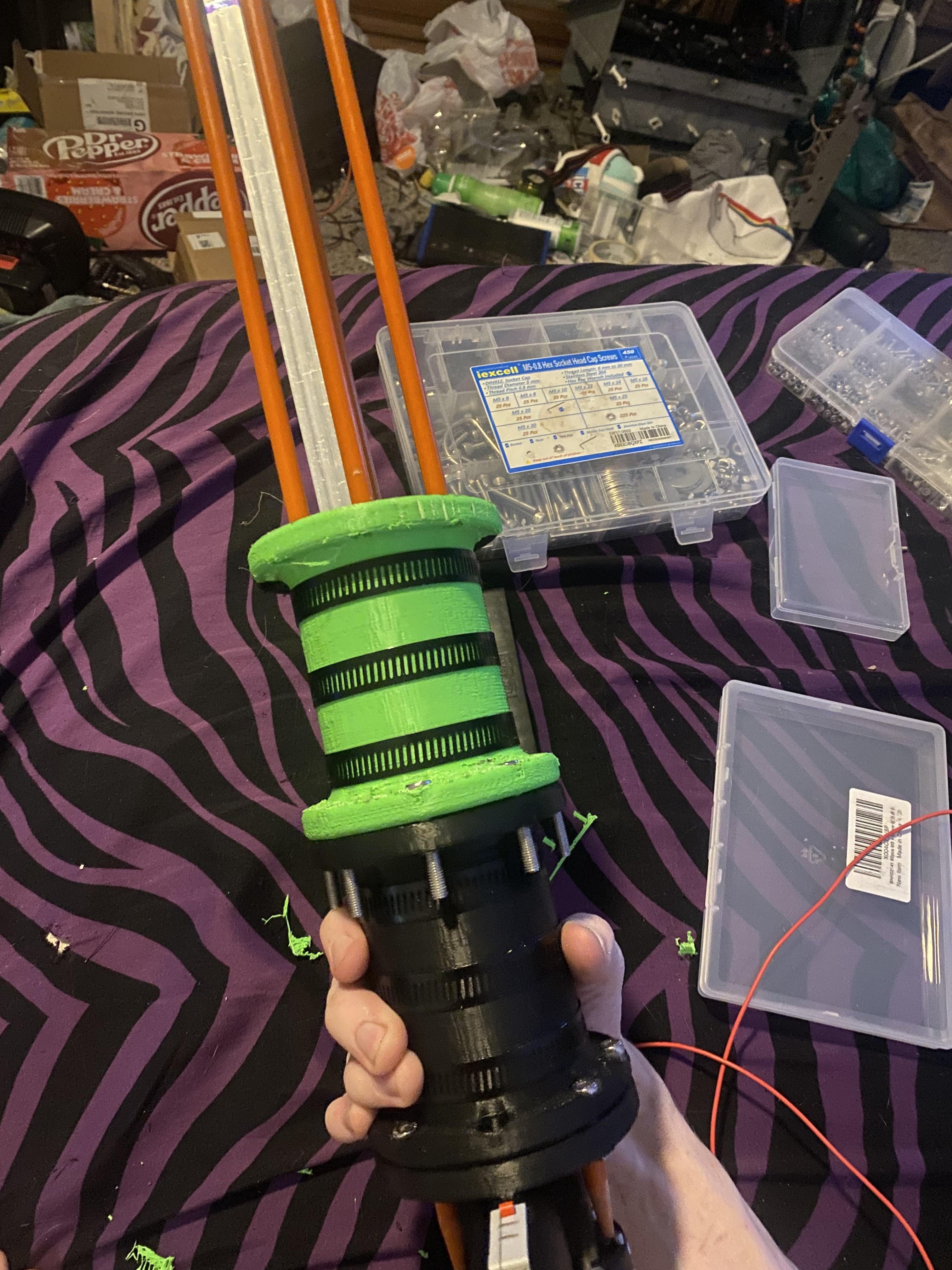
When complete, Karmas_the_bitch estimates it will weigh 80+lbs, and will fire a 1.5g projectile at 250-300 meters per second. He describes it as a “ viable self defense option.” I could not agree more.
This is early days for this project, but you’d better believe that I’ll stay on top of it as it develops. Push the frontiers!
PrintYour2A Teases Cursed Mac / Glock Hybrid

The Mock isn’t real. The Glac can’t hurt you. At least not for now, but just wait until release…
Developer PrintYour2A is often brilliant, sometimes cursed, and never boring. To be honest, I’m somewhat amazed that nobody has done this before.
News:
In this section we’ll review major news events either originating in the 3D2A space, or particularly pertinent to this space.
INMC Returns! Buy Kits and Get Launching!

A few years back, the one-stop shop for 3D printed launchers was INMC. They focused almost entirely on launchers and other signaling-type devices, providing high quality kits and fun merch. And then they went dark.
But you can’t stop the signal! INMC is back with a new website and several improvements. They’ve brought back the core kits, including the NT79, the Nameless, the Odin, the BALLS and more! (They also offer kits for the extremely cool PROOF airgun, which remains on my todo list).
In addition to bringing back the classics, they’re expanding, switching from steel fencepost barrels to aluminum seamless, selling aluminum shell hulls, commissioning wood furniture for kits such as the NT79, and expanding their merch section!

Check out their site and give their Instagram a follow while you’re at it! Tell ‘em Alyosha sent you!
SCS Cucks Out

I’ve been seeing rumors for a few weeks that the up-until-now beloved SendCutSend was rejecting orders for “parts designed similarly to firearms parts”, and regrettably it appears this is true. Several users have had orders cancelled, and have received the same anodyne email referring to the “updated terms of service.”
So that sucks. We have become increasingly dependent on SCS in the community, and I won’t pretend that losing them doesn’t hurt. What do we do now?
Option one is to use alternative services. A few have been recommended:
Reports so far indicate that none of these can offer quite as good pricing as SCS did, with OSH Cut apparently being the most expensive, but also potentially the most willing to work with our brand of parts. I expect the community will experiment with these services and settle on one over time.
Option two is to find a local manufacturer in your area with a laser or waterjet and ask them to do a small run. This requires talking to strangers, a difficult ask for internet denizens, but I encourage you to give it a try. Search for machine shops in your area and call them up - you may be surprised what you’ll find!
Option three is to bring cutting in house with the Rack Robo machines! The Betta Wire is a desktop sized 4-axis WEDM machine; the Wire EDM Starter Kit is an earlier version of the same project that attaches to a 3D printer’s motion system to perform 3-axis WEDM. Both come in kit form, meaning you must build it yourself, but both are highly accessible ways to bring custom flat cutting into your garage or apartment!
Some have used the loss of SCS to advocate for no longer using custom cut flats in 3D2A. My feelings on this are complicated. One of the core principles of 3D2A is DIYing as much as you can, and a design that can be fully DIY’d is always more interesting than one that relies on commercial parts.
Yet it is also the case that a released design is better than a design stuck in beta hell while we figure out how to DIY parts that could easily be provided commercially.
Furthermore, a built design is better than an unbuilt design, and it is simply a fact that more people will build an easy design vs. a hard design. The Rogue-9 / Rebel-9 is a great example of this - it has an incredibly cool fully DIY bolt, perhaps the best and most reliable of its sort. Yet virtually nobody builds it, and those that do usually do so with one of my machined bolts.
Above all else, the goal of 3D2A should be to get people building guns. Anything that promotes that, I am in favor of. As such, I hope that all designers will seriously consider exploring alternative, more DIY-friendly ways to add metal where it’s needed (Meccano?), but I also encourage those designers to not let the difficulty of such a feat hold them back from releasing.
In conclusion, RIP to SCS. You were a real one until they got to you. The community will continue without you. The signal will never be stopped.
Serialless Returns in Serial Form

Unlooked for, he returned! The Serialless / Roast / WeTalkShit show was a staple of the guncad community for some time. The show is over, but the brand has returned in magazine (or serial?) form!
Their first issue features an interview with the very based iPrintShit, designer of such bangers as the Glocknovsky, the Paragon-9, and the RPG-FE (which is on my shortlist to make a fully DIY version of someday). Several cool looking community builds are also featured.
Sign up at the Serialless website to get future issues in your inbox!
Other Links:
This section will collect any other links I find interesting. These may be older designs I want to share, releases I find notable but don’t have much commentary on, or anything else that catches my eye.
It’s always a good day when Proof1447 posts a release. Today’s example is a printable backup iron sight (folding!) for the M4. Yet another example of a part that you’d probably pay $30 - $50 for, easily printable for near-free. Good work!
3D2A is built on open source, and one of the fundamental FOSS insights is that once something has been built, there’s no reason for someone else to rebuild it. Sharing is caring! To this end, developer Gerald Katz has released 3D printable thread profiles for over 25 common thread profiles, imperial and metric, pre-toleranced for printing. Use them to help you model printed suppressor mounts and much more!
Calling all Lima Six fans! This printable Predator Pack allows you to feed your upper through a linked belt attached to an ammo backpack. Fire your barrel until it melts! Build this and become a goddamn sexual tyrannosaurus, just like me.
We continue to get reset triggers for UMP builds! The UMP RAD V1.1 from MSRPatton80 adapts the UMP11/9 lower for use with the RAD. Based!
About the Guncad Digest:
Thank you for reading this issue of the Guncad Digest! Please send us your feedback and suggestions for improvements on the issue.
The Guncad Digest is sourced using the very excellent Guncad Index, from /r/3D2A, and from readers like you. If you know of a project you think should be featured, send it our way!
This issue was compiled and authored by Alyosha from 3D2A.com. We sell high quality parts kits for some of the best DIY guns available - if you’re looking for your next gun build, come check us out!